
Being an Australian and an alumna of neighbouring rival Magdalen College Oxford, this Kat has always wondered about the accuracy in the naming of New College Oxford (NCO). New College was founded in 1379 by William of Wykeham (1324-1404), Bishop of Winchester, as ‘The College of St Mary of Winchester at Oxford’. Almost immediately it became known as ‘New College’ to distinguish it from another Oxford college which was already dedicated to the Blessed Virgin Mary, that is Oriel which was founded in 1326. Given that this Kat's country was only colonised in the 1780s, it feels more than a slight stretch to call something founded some 400 years before that as 'new'.
 In June 2011, the philosopher AC Grayling announced the establishment of the New College of the Humanities (NCH), a private for-profit undergraduate college in London which would offer tuition in economics, English, history, law and philosophy from October 2012. Teaching will be done by a 'team of international, academic all-stars' including biologist Steve Jones, geneticist Richard Dawkins and historian Niall Ferguson. Prior to the announcement, in May 2011, NCH filed an application for the trade mark NEW COLLEGE OF THE HUMANITIES in classes 09, 16, 41 and 42. At present, the trade mark is under examination.
After the announcement by NCH, Curtis Price of NCO said he was 'not very pleased' by NCH's choice of name -- which had been widely abbreviated to New College in the press and online. He added:
'It is an ill-chosen title for this venture in Bloomsbury, because it is setting out to provide an education similar to a college in Oxford or Cambridge ... I am trying to persuade him to use another name ... if [NCH] is a farce, a joke, then our name is tainted ... I can't think of any reason in the world why anyone who could pay £9,000 and come here [to NCO] and enjoy a further £9,000 subsidy, would rather go to the New College of the Humanities and pay £18,000.'

Until this point, NCO had not sought to register its name as a trade mark. However, it seems to have been spured into doing so by the actions of NCH. NCO filed an application for the trade mark NEW COLLEGE OXFORD in classes July 2011 in 06, 09, 14, 16, 18, 21, 25, 35, 41, 42, 43 and 45 [Merpel excitedly notes that class 45 includes 'licensing of intellectual property' ...]. The mark received an expedited examination in August 2011, was advertised in September 2011 and registered last Friday, 9 December 2011.
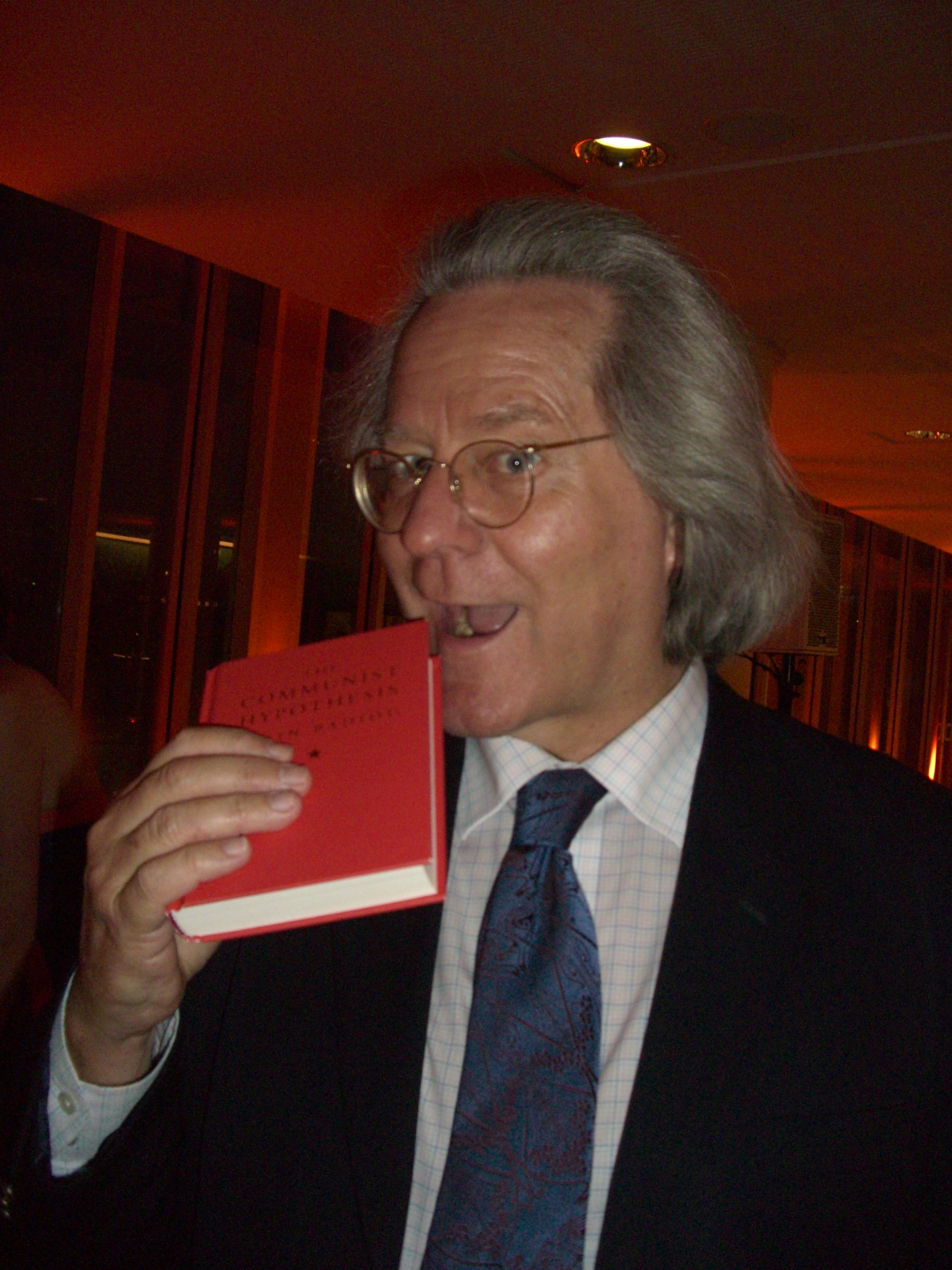 |
| A. C. Grayling, apparently biting a book .. |
'There's nothing to worry about ... There's already a New College in Swindon and Nottingham. I take it it as a compliment'.The IPKat wonders how this will play out. New College Swindon was
 founded as Sixth-Form College in 1984 and later added a number of specialist vocational courses and degree courses. New College Nottingham is an amalgamation in 1999 of education establishments in the City of Nottingham
  and caters for school students from the age of 14 through to degree level. Neither of these colleges has sought to register its name as a trade mark their and neither offers an educational programme comparable with that of Oxford or Cambridge.
Merpel wonders which side of the fence Richard Dawkins will sit on this one: although being touted as part of the 'team of international, academic all-stars' at NCH, since 2008 he has also been an Emeritus Professor at NCO. The IPKat, noting that NCH proposes to offer Intellectual Property Law as one of its course options, wonders who might be invited to teach it ...
The battle for 'New College'
 Reviewed by Catherine Lee
on
Monday, December 12, 2011
Rating:
Reviewed by Catherine Lee
on
Monday, December 12, 2011
Rating:
Reviewed by Catherine Lee
on
Monday, December 12, 2011
Rating:


 Follow the IPKat on LinkedIn
![[GuestPost] G1/24: Tuning in! A take on the state of proceedings before oral proceedings](https://blogger.googleusercontent.com/img/b/R29vZ2xl/AVvXsEjZhEivE5bp7QOwZsyZXAXbVNYSmLjUthkB2Q7fm1_dpB97u5lIQeyWT9ZadUTAH3Z-hXn13VpW4vBDRPx9emCnoDV6tbUTkyvfmqPv1nNInL8XMdrAtSZ2hcRQr2LjxKovC9wTk_XyZxQ0CtX1MUrO_Muz3OJ4ld8AftymsdUmKD7xNksYMwk6/s150/Picture%201.png)


![[Guest book review] The Handbook of Fashion Law (with a discount code)](https://blogger.googleusercontent.com/img/b/R29vZ2xl/AVvXsEgB4h2AdqJKwq9O3Ft4Mb7C39tv_NeFpkzrOfvhIsuwAkM_ops2Hgj7fdwzq_TQsjQDvQrQa-yyC9Q9pNiugseXRlUaMdsr_cmYUbh9lH8HDECMCbsTuNboVgpafyEhkgDkVS6ruHkuz8Sx0QVGI_1S8R9kbsHdNIYrRjqhyphenhyphen010_txjJUYvlZOtWA/s150/Fashion%20Law%20Book%20Bicture.jpg)


 Posts
Posts


Speaking mischievously (and as a proud Cantabrian to boot), since the Trade Marks Act 1994 does not permit the registration of descriptive trade marks without proof of acquired distinctiveness, or deceptive trade marks under any circumstances, sure New's registration is invalid anyway? Logically, New is either new or old. Therefore, its trade mark is either descriptive (because the college is new, which it isn't) or deceptive (because it is in fact very old). Clearly the IPO has taken a view on this and granted the registration - but what better person to exploit such a paradox on appeal than renowned philosopher Professor Grayling?
ReplyDeleteWhy are we trying this in the court of public opinion, it would seem that NCH is devoid of distinctve character and Oxford can now go ask the court for an injunction to prevent this unoriginal Humanities school using a confusingly similar name. I imagine it has a few resources for that purpose.
ReplyDeleteNaturally they would not have a case but for the juxtaposition of NEW and COLLEGE since Cambridge had a New Hall for many years but we rebranded as Murray Edwards College and registered the trademark
It is a point of concern to us that gangs of tourists turn up seeking out 'New College', presumably hoping to find something appropriately glitzy, concrete & glass, vibrant & C21 here at Oxford and encounter only yet another heap of old stones and decaying dons - since we charge £2 to tourists one day there will surely be a complaint to Trading Standards? Perhaps we sd be 'Old College' or even 'Lower Hogwarts' - since we did have a bit of Harry Potter filmed here (Christ Church, of course,is Hogwarts Magna). Bursar, New Collge Oxford (TM).
ReplyDeleteI'm missing out on where the confusion is between "Oxford" and "Humanities"?
ReplyDeleteIs it something to do with Oxford's and Cambridge's hold over everything in public and professional life?
I see that CIPA didn't take the inquiry into diversity in the profession at all seriously if the article by Andrea Brewster in the CIPA journal is anything to go by either.
Fine to have a few minorities as long as they went to the right place, but we don't want any of that common sort getting in!
Social diversity! We'll soon be allowing successful EQE candidates in without taking our own exams.
When will be seeing Saint Kat's College?
ReplyDeleteAnonymous at 6:55 PM: Thanks for the tip about Andrew Brewster's comments on diversity (CIPA journal October 2011, page 639). I tend to skip over her diary page in search of something with a little more substance.
ReplyDeleteIt is disappointing that our council consider the mere prospect of reviewing diversity in the profession (let alone doing anything about it) to be "complete tosh". I appreciate the diary is supposed to be light hearted, but this trivialises an important subject. We may be "a gnat-bite on the ankle of the wider legal community" but this does not mean we are above scrutiny.
I take Andrea's point that it is impossible to ensure diversity within a single small firm, but if the evidence suggests that the profession as a whole is overpopulated with "white middle class males with beards and white middle class males without" (for the record I am the latter) then perhaps the reasons for this should be examined.
Combining diversity and pedantry - the first colonisation of Australia is actually believed to be 75-100 000 years ago, some 30-50 000 years before the first records of humankind in GB.
ReplyDeleteSimply evidence that the Australians may have invented record keeping long before Britain?
ReplyDeleteRegarding diversity, concerns and laws have mainly focussed on race and sex, with the highest profile concerns always being in respect of the number of female members of any particular profession or the like. More female MPs, more female members of the Board of FTSE 100 companies. More female members of the Supreme Court.
Race is dealt with more in the US, but little in the UK. Social diversity is never ever worthy of mention. Or should I say that anyone who dares mention it will be accused of having a chip on their shoulder. We can take it as read that the CIPA article wouldn't have been so light hearted (being generous, but I won't be critical as I'm sure there would have been no ill-intent) on the subject of race or sex.
It is illegal to discriminate on the grounds of race or sex, but we are all free to discriminate on the grounds of social standing. This does not make it ok to discriminate for any reason.
The patent profession is only a small part of the wider legal community, but the inquiry will show the lack of diversity across the board. It is too easy to be dismissive and say that the professions only recruit the best educated and therefore the lack of diversity is caused by problems in the state education sector.
The profession can happily sit on the high ground and say "nothing to do with us Gov" and carry on regardless, or it can accept the existence of a real problem for society and try and do something about it.
Working backwards, the majority of trainee intake is from Oxford and Cambridge. Oxbridge intake is disprportionately from private schools. The Majority of bright kids from the state schools aren't going to get a look in
Like attracts and recruits like. White middle class (male AND female) recruits white middle class. I am not one for positive discrimination and quotas, but I would say that firms need to take the time to consider applicants from different backgrounds to their own. Assess candidates based on their ability. Consider the fact that candidates from other universities may be equally able and their first in microbiology from Univ X is equivalent to a first from Oxbridge.
Who knows! The pass rate of the patent exams may improve if source of occurs more widely. Diversity is beneficial and it is how nature improves things.
Much intake into the professions is based on contacts and knowledge/experience of the profession via family or family friends. Many people from "working class" backgrounds have no understanding of the professions or, in the case of patent agents, its existence. There needs to be more education and career advice in schools provided by the professions themselves. Some of the biggest London Law firms operate outreach programmes in the inner cities. Guess what? These kids turn out to be higly intelligent, hard working and very successful!
Does the diversity issue not warrant a posting of its own? A chance for CIPA to comment also? Or, will this be one of those occasions where everyone stays quiet until the issue has gone away?
ReplyDeleteThis comment has been removed by a blog administrator.
ReplyDelete